.png)

Pre- and Post-Competition Recovery Protocols for Sport Horses: An Integrative Guide for Barrel Racers, Eventers, and Show Jumpers

Updated: Sep 9
Whether you're running a cloverleaf pattern in under 16 seconds, galloping a cross-country course, or jumping a technical 1.40m track under the lights, your sport horse is a high-performance athlete. And like every elite athlete, what you do between efforts matters as much as the effort itself. Recovery isn't the boring part of training — it's where adaptation happens, where soreness is managed, and where soundness is protected across a long season.
This guide lays out a complete, practical recovery framework built around red light therapy (photobiomodulation), with treatment maps by body zone, session timing for each phase of competition, and — importantly — the complementary therapies and supplements that pair with light based on how it actually works in the body. At EquiGlow Therapeutics, we design wearable red light products around equine anatomy — from the poll to the topline to the lower limb with our new 2.0 Leg Wraps — those whose athletes rely on exactly this kind of integrated approach.
Let's build your protocol.
Why Red Light Therapy Belongs at the Center of a Recovery Program
Red and near-infrared light (typically 630–660 nm and 810–850 nm) penetrates skin and soft tissue and is absorbed by the mitochondria — the energy engines inside every cell. The downstream effects map almost perfectly onto what a fatigued equine athlete needs:
More cellular energy (ATP) for tissue repair and muscle recovery
Reduced exercise-induced inflammation without blunting healthy adaptation
Improved local circulation, delivering oxygen and nutrients to working tissue
Collagen synthesis support for tendon and ligament resilience
Enhanced lymphatic drainage to clear metabolic waste after hard efforts
Reviews in the veterinary literature describe photobiomodulation as a safe, non-invasive method to support tissue repair and reduce pain in horses. It's worth being honest that standardized, validated equine protocols are still emerging — so think of red light as a well-founded, low-risk recovery tool used alongside good horsemanship, not a guaranteed fix on its own.
What makes light such a strong anchor for a recovery program is that it stacks beautifully with other modalities. Several of the most effective recovery therapies share red light's core mechanisms — circulation, inflammation control, and tissue repair — which means they reinforce rather than duplicate each other. More on that below.
Mapping the High-Demand Zones by Discipline
Different sports load different parts of the horse. Knowing where your horse carries the most stress is the foundation of an efficient protocol.
Barrel Horses
Explosive acceleration, hard deceleration, and tight collected turns place enormous torque on the body.
Hindquarters and hips — the engine of acceleration; gluteals and hamstrings take the brunt
Lower back and loin — absorbs the shock of rate and direction change
Poll and neck — horses brace through the neck during turns
Hocks and stifles — repeated collection and push-off create cumulative joint stress
Forelimb tendons and fetlocks — absorb deceleration and landing forces
Eventers
The three phases — dressage, cross-country, stadium — demand sustained performance across consecutive days.
Back and topline — dressage engagement plus galloping fatigues the entire topline
Poll and TMJ — collection and the rider's cross-country position create tension
Shoulders and forelimbs — impact over fixed fences is significant
Hips and hindquarters — galloping and jumping from behind demand sustained output
Lower limbs and tendons — vulnerable over varied terrain
Show Jumpers
Repeated maximal effort, technical precision, and fast recovery between rounds.
Shoulders and trapezius — thrust and extension over fences create chronic tension
Back (thoracolumbar junction) — a primary stress point during bascule and landing
Hindquarters — the power source for height and scope
Poll and neck — tension from collection and frame
Forelimb soft tissues — landing concussion on hard footing is cumulative
The Integrative Competition Recovery Protocols for Sport Horses
Here's how to combine the EquiGlow Head and Neck Piece, Hip and Shoulder Wrap, Large Back Piece, and 2.0 Leg Wraps with complementary therapies across the three phases of competition.
Phase 1: Pre-Competition (24–48 Hours Before & Day Of)
The goal is readiness, not added fatigue: optimize circulation, release residual tension, and promote relaxation.
48 hours before: A full-body red light session using all four EquiGlow pieces — the Head and Neck Piece, Hip and Shoulder Wrap, Large Back Piece, and 2.0 Leg Wraps (15–20 minutes per zone) — resolves lingering training soreness. The 2.0 Leg Wraps are especially worth including here: the lower limb takes a beating in every discipline, and pre-competition is the ideal window to support tendon and ligament tissue before you ask for maximal effort. This pairs naturally with light massage or a gentle bodywork session — red light and massage both drive circulation, so applying light to warm, recently-massaged tissue is a logical one-two. A proper dynamic warm-up and mobility/stretching routine in the days before competition keeps fascia supple.
Morning of (2–4 hours before first ride): A shorter session focused on the Head and Neck Piece (10–15 min) to release poll tension that builds during hauling and stabling, plus a brief Large Back Piece session (10 min). This is also when electrolyte support matters most — a horse that hauls and competes in heat needs replenishment to maintain performance and reduce cramping risk (always per your vet's guidance for your horse and conditions).
Timing note: Leave roughly a 2-hour buffer between red light treatment and maximal effort. Light increases circulation and cellular activity — give the body time to respond before you ask for performance.
Phase 2: Immediate Post-Competition (Within 1–3 Hours)
This is where red light delivers its highest value — while the horse is still warm and circulation is elevated, before stiffness sets in.
After a brief cooldown walk, apply:
Hip and Shoulder Wrap (15–20 min) — top priority for barrel horses and eventers
Large Back Piece (15–20 min) — critical for jumpers and eventers after a full course
Head and Neck Piece (10–15 min) — priority for dressage, barrel racing, and same-day haulers
2.0 Leg Wraps (15–20 min) — for the hardest-working lower limbs after the muscular zones are addressed
A note on sequencing the lower limb, because this is where people get confused. Cold therapy and red light both have a place after hard work — they just serve different goals and belong at different moments. In the acute window immediately after a maximal effort (think the first 20–30 minutes, when there's heat and acute strain in a tendon), cold therapy comes first to manage that acute inflammation. Then, once the limb has cooled and you're into the recovery phase, the 2.0 Leg Wraps support circulation, tissue repair, and lymphatic drainage in those same tendons and ligaments. Cold to settle the acute response; light to drive the recovery that follows. Treat the large muscular zones (back, hips, shoulders) with light in parallel — those don't need the cold step.
Phase 3: The 48-Hour Recovery Window
Returning home is not the time to resume full training.
Day 1 (light or no work): Full red light protocol with all four pieces, plus a full-body assessment for heat, sensitivity, or asymmetry. Pay particular attention to the lower limbs the day after a hard effort — the 2.0 Leg Wraps are valuable here for supporting tendon and ligament recovery while you monitor for any filling or heat. This is an ideal day for a thorough massage or bodywork session, and for gentle hand-walking or turnout to keep the lymphatic system moving.
Day 2 (light hack or groundwork): A targeted red light session on the zones that showed the most tension, paired with mobility and stretching work. If the legs were working hard, continue the 2.0 Leg Wraps. Maintain the poll and neck routine regardless — it supports the nervous system as much as the muscles.
Zone-by-Zone Treatment Map: Which EquiGlow Product Goes Where
The EquiGlow Head and Neck Piece
Targets: Poll, occipital crest, cervical vertebrae, nuchal ligament, brachiocephalicus and splenius muscles, jowl and TMJ.
The poll is one of the most mechanically and neurologically significant zones on the horse. Tension here shows up as resistance to contact, uneven bend, difficulty with lateral work, and even anxiety. For barrel horses it's aggravated by the torque of fast turns; for jumpers and eventers, by collection and the bascule over fences. Beyond the musculoskeletal benefit, treating the poll supports nervous-system relaxation — invaluable for horses settling into an unfamiliar show environment.
Pairs well with: craniosacral or gentle in-hand poll-release bodywork, and magnesium support for horses prone to tension and reactivity (discussed below).
The EquiGlow Hip and Shoulder Wrap
Targets: Gluteals, iliopsoas, biceps femoris, semimembranosus, semitendinosus (hind); trapezius, infraspinatus, supraspinatus, deltoid (front); point of hip and point of shoulder.
These are the powerhouses of the equine athlete — and the zones where soreness, asymmetry, and performance-limiting fatigue most often appear. For barrel horses, the hip and gluteal complex strains during acceleration and tight turns. For jumpers and eventers, shoulder musculature absorbs the concussive force of landing across a full day of rounds.
Pairs well with: sports massage and PEMF (pulsed electromagnetic field) therapy for the large muscle groups, plus joint-support nutrition where the hip, stifle, and shoulder joints are working hard.
The EquiGlow Large Back Piece
Targets: Longissimus dorsi, thoracolumbar fascia, iliocostalis, multifidus, the thoracolumbar junction, and the loin/sacral region.
If one zone unifies every discipline, it's the back. A horse that can't swing freely through the back can't engage from behind, can't use itself over a fence, and can't run a clean pattern. Back tension is the single most common — and most undertreated — physical complaint in sport horses.
Pairs well with: chiropractic/osteopathic evaluation (correct saddle fit first), massage along the longissimus, and a sound core/topline conditioning program so the muscle being treated is also being correctly developed.
The EquiGlow 2.0 Leg Wraps
Targets: Superficial and deep digital flexor tendons, suspensory ligament, cannon region, fetlock, and the soft tissue of the lower limb.
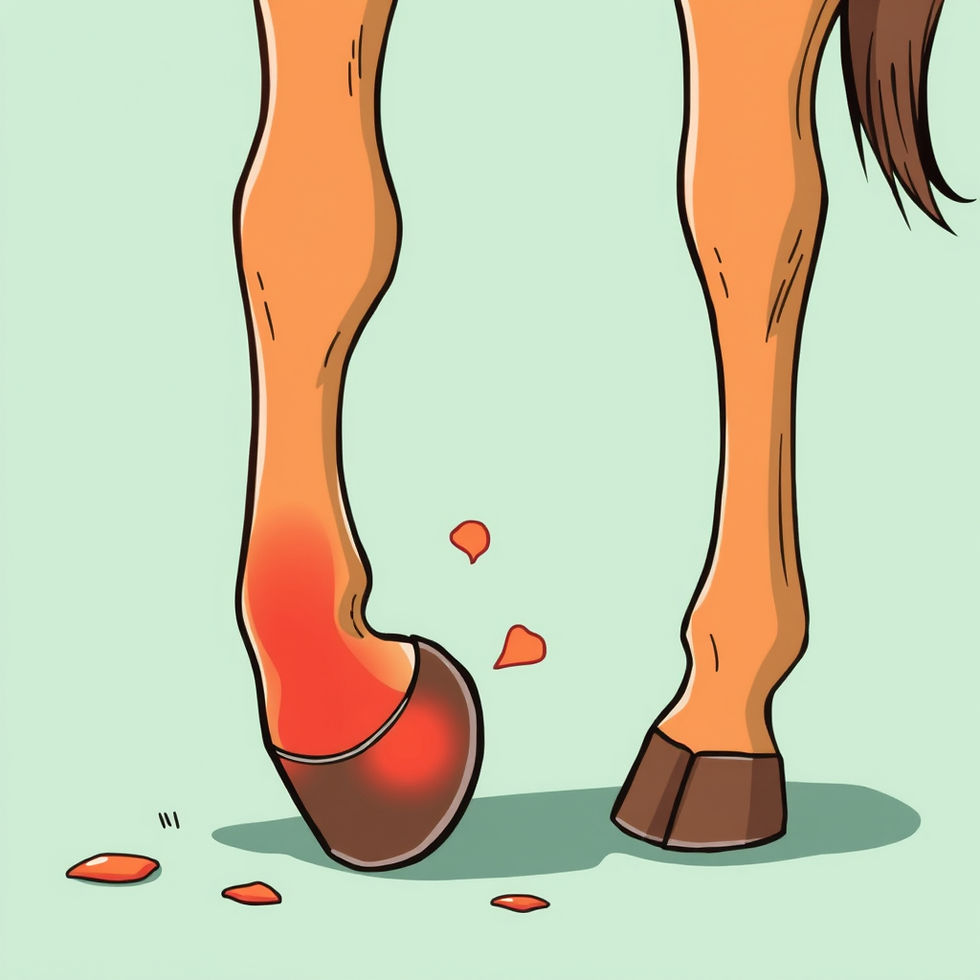
The lower limb is where sport-horse careers are most often made or lost. Tendons and ligaments have a notoriously poor blood supply compared to muscle, which is exactly why they heal slowly and why supporting their circulation matters so much. Every discipline in this guide lists the lower limb as a high-demand zone — barrel horses absorbing deceleration and turning forces, eventers working over varied terrain, jumpers landing repeatedly on hard footing. The 2.0 Leg Wraps deliver red and near-infrared light directly to these structures in a hands-free, wrap-around design, making consistent daily lower-limb support practical even in a busy barn. This is the piece that closes the loop on a true full-body protocol: poll to topline to the ground.
Pairs well with: cold therapy in the acute post-effort window (cold first, then light), supportive/standing bandaging where appropriate, controlled hand-walking to promote tendon glide, and omega-3 and joint-support nutrition to address soft-tissue inflammation from the inside.

Complementary Therapies That Pair With Red Light — and Why
The reason these stack so well isn't marketing — it's mechanism. Red light works by boosting cellular energy, circulation, and tissue repair while calming inflammation. The best complementary therapies either amplify those same pathways or address something light doesn't.
Massage and sports bodywork. Both red light and massage increase local blood flow and lymphatic drainage. Massage adds mechanical release of adhesions and muscle tension that light alone won't resolve. Sequencing tip: massage to release and mobilize, then red light to support recovery in the same tissue.
PEMF (pulsed electromagnetic field) therapy. PEMF and photobiomodulation are often used together because they target recovery through complementary routes — PEMF influences cellular charge and circulation across larger, deeper tissue volumes, while red light delivers targeted mitochondrial support. Many performance barns alternate or layer the two.
Cold therapy and hydrotherapy. This is light's natural counterpart for the lower limb. Cold constricts vessels and limits acute inflammation in tendons and joints right after hard work; red light supports repair and circulation in muscle. Use cold for the acute distal limb, light for deep muscular recovery — different jobs, no conflict.
Stretching, mobility, and dynamic exercise. Carrot stretches, in-hand mobility, and a correct warm-up/cool-down maintain range of motion and fascial glide. Treating a muscle with light is far more valuable when that muscle is also being moved through its full range.
Acupressure and acupuncture. Many practitioners target the same points with red light that they'd use in acupressure — the hock, stifle, and back association points, for example. Light over key points can be a gentle, needle-free complement for horses that benefit from point-based work.
Chiropractic and osteopathic care. These address skeletal alignment and joint mobility that soft-tissue therapy can't. Red light supports the surrounding musculature so adjustments hold better and the horse is more comfortable through the process. (Always rule out saddle fit and dental issues as root causes first.)
Supplements That Support Recovery — Used Wisely
A quick, important caveat: supplements should be chosen with your veterinarian, matched to your horse's individual needs and diet, and checked against your competition's medication and prohibited-substance rules (FEI, USEF, PRCA, etc.). What follows is general education, not a prescription. The throughline is simple — red light gives cells more energy and a calmer environment to repair in; supplements supply the raw materials and reduce the inflammatory load. They work on the same problem from opposite ends.
Electrolytes. The most universally relevant. Horses lose sodium, chloride, potassium, magnesium, and calcium in sweat, and replacing them supports performance, hydration, and muscle function — especially in heat and on haul days.
Omega-3 fatty acids (EPA/DHA). Among the best-studied anti-inflammatory nutritional supports. Because red light also modulates inflammation, omega-3s reinforce that pathway from the inside — a logical pairing for hard-working joints and soft tissue.
Vitamin E and antioxidants. Intense exercise generates oxidative stress. Vitamin E is a key antioxidant for muscle and nervous-tissue health, particularly relevant for horses in heavy work or with limited green-grass turnout.
Joint-support nutrition. Ingredients such as glucosamine, chondroitin, hyaluronic acid, and others are widely used to support cartilage and joint comfort in performance horses. The mechanism-based logic: red light supports the collagen-producing cells while these nutrients supply building blocks — revving the engine and filling the tank.
Magnesium. Often used to support normal muscle and nervous-system function, especially in tense or reactive horses. It complements the calming, poll-focused side of a red light routine.
Protein and amino acid support (e.g., quality protein, lysine). Muscle repair requires adequate, good-quality protein. Light increases the cell's capacity to rebuild; amino acids are the literal building blocks it rebuilds with.
The integrative principle across all of these: don't think of light, therapy, and nutrition as separate buckets. They're one strategy speaking the same biological language — energy, circulation, inflammation control, and raw materials for repair.
Discipline-Specific Quick-Reference Protocols
Barrel Racing
Timing | Priority Zones (EquiGlow) | Complementary Add-On |
48 hrs before | Full body — all four pieces (incl. 2.0 Leg Wraps) | Light massage; mobility work |
Morning of (2–4 hrs prior) | Head & Neck + Back | Electrolytes |
Post-run (1–3 hrs) | Hip & Shoulder + Back; 2.0 Leg Wraps after cold | Cold therapy on lower limbs first, then Leg Wraps |
Evening | Head & Neck; 2.0 Leg Wraps | Hand-walking |
Day 1 home | Full body — all four pieces | Full massage/bodywork |
Eventing (3-Phase)
Timing | Priority Zones (EquiGlow) | Complementary Add-On |
Night before dressage | Full body — all four pieces (incl. 2.0 Leg Wraps) | Stretching; electrolytes |
Morning of dressage | Head & Neck | — |
Post-dressage | Back + Head & Neck | Light massage |
Pre-XC (2+ hrs prior) | Back + Hip & Shoulder + 2.0 Leg Wraps | Electrolytes |
Post-XC (1–3 hrs) | Full body — urgent | Cold therapy on legs, then 2.0 Leg Wraps |
Post-SJ / show end | Full body — all four pieces | Hydrotherapy |
Days 1–2 home | Full body — all four pieces | Massage; mobility; turnout |
Show Jumping
Timing | Priority Zones (EquiGlow) | Complementary Add-On |
48 hrs before | Full body — all four pieces (incl. 2.0 Leg Wraps) | Bodywork; saddle-fit check |
Morning of (2+ hrs prior) | Head & Neck + Back | Electrolytes |
Between rounds (2+ hr gap) | Back + Hip & Shoulder | Cold therapy on legs |
Post-final round | Full body — all four pieces | Cold therapy, then 2.0 Leg Wraps |
Evening | Head & Neck; 2.0 Leg Wraps | Hand-walking |
Day 1 home | Full body — all four pieces | Massage; PEMF |
General Guidelines for Safe, Effective Use
Consistency beats intensity. Regular sessions over weeks outperform occasional long ones. More is not better — the dose response is biphasic.
Treat clean, dry skin/coat. Mud and dirt block light. Dark coats absorb slightly less surface light, but near-infrared still penetrates to deep tissue.
Sequence smart. Massage or cold first where appropriate, then light. Leave a buffer before maximal effort.
Layer the program. Red light is the anchor; therapies and nutrition are the reinforcements. The whole is greater than the parts.
Know the rules. Red light therapy is drug-free and non-pharmacological and does not appear on major prohibited-substance lists — but always verify supplements against your sanctioning body's rules.
Loop in your professionals. Vet, farrier, body worker, and saddle fitter are part of the team. Light supports their work; it doesn't replace it.
Real Barn, Real Results: The Lothlorien Competition Horses
EquiGlow Therapeutics is proud to sponsor the Lothlorien competition horses — a program that lives this integrated philosophy. The Lothlorien horses fold the full EquiGlow lineup into their competition prep and recovery, alongside the bodywork, conditioning, and nutrition that keep elite athletes sound across a demanding season. We also sponsor horses and riders from Grayton Farms in Alberta, Bosch Farms rider Femke Courchaine and others in the industry.
We believe the horses that win on the weekend are the ones cared for best during the week — and that conviction guides everything we build.
Build Your Protocol with EquiGlow Therapeutics
Whether you're loading for your first rodeo, heading to an event, or managing a full jumper circuit, the EquiGlow line gives you a professional-grade, barn-friendly foundation for recovery:
EquiGlow Head and Neck Piece — poll, cervical musculature, TMJ, and jowl
EquiGlow Hip and Shoulder Wrap — gluteals, iliopsoas, trapezius, and shoulder musculature
EquiGlow Large Back Piece — longissimus dorsi, thoracolumbar junction, and loin
EquiGlow 2.0 Leg Wraps — flexor tendons, suspensory ligament, cannon, and fetlock
Together, these four pieces cover the horse from poll to pastern. Pair them with the complementary therapies and nutrition above, and you've got a complete, mechanism-based recovery system — not a collection of disconnected gadgets.
Shop the full collection at equiglowtherapeutics.ca and give your sport horse the recovery they've earned.
Recovery Protocols for Sport Horses
Check out our podcast companion episode to learn more: Before or After? When is the best time to use red light therapy?
This article is for informational purposes only and is not veterinary advice. Always consult your veterinarian before starting any new therapy or supplement, and verify all products against your competition's medication and prohibited-substance rules.


Comments