.png)

Hoof Abscesses, Thrush & White Line Disease: How Red Light Therapy Supports Hoof Recovery at the Cellular Level

“No hoof, no horse.” It is one of the oldest sayings in horsemanship, and it remains true today. The hoof is a marvel of biological engineering, but it is also one of the most vulnerable structures on the horse. When infection takes hold — whether as a painful abscess, a foul-smelling case of thrush, or the slow, creeping separation of white line disease — it can sideline even the soundest horse and test the patience of the most dedicated owner.
At EquiGlow Therapeutics, we hear the same questions again and again: “Is there anything I can do to speed this up? Anything drug-free I can add to my farrier and vet’s plan?” Increasingly, horse owners are turning to red light therapy — known scientifically as photobiomodulation (PBM) — as a complementary tool for hoof health. In this article, we’ll look honestly at what these three conditions actually are at the cellular level, what the research does and doesn’t yet show, where the strong evidence ends and the anecdotal evidence begins, and how to use red light therapy sensibly as part of a complete hoof-care program.
A note before we begin Red light therapy is a complementary modality. It does not replace your veterinarian or farrier, and it is not a substitute for proper debridement, drainage, hygiene, and trimming. Always involve your hoof-care professionals first. Think of red light as a way to support your horse’s own healing machinery — not as a stand-alone cure. |
Understanding the Three Conditions
Although they’re often lumped together as “hoof infections,” abscesses, thrush, and white line disease are distinct problems with different causes, different tissues involved, and different healing demands. Understanding what’s happening in the tissue is the key to understanding where red light therapy may — and may not — be able to help.
Hoof Abscesses
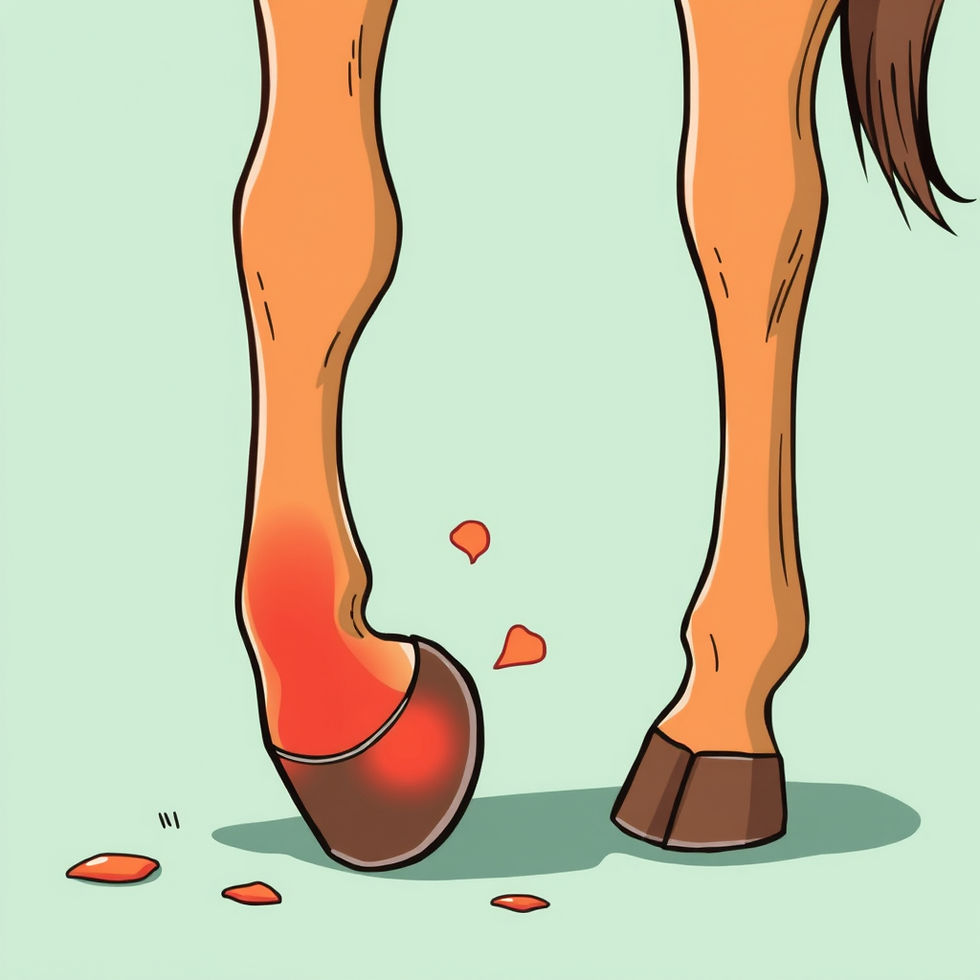
A hoof abscess is a localized pocket of infection, usually bacterial, that becomes trapped within the hoof capsule. It typically begins when bacteria enter through a crack, a bruise, a puncture, or a compromised white line, then become sealed inside the rigid hoof. As the immune system mounts its response, pressure builds in a structure that cannot expand — which is exactly why an abscess can cause sudden, dramatic, non-weight-bearing lameness that owners often mistake for a fracture.
The primary treatment is drainage — allowing the abscess to rupture and release pressure, whether naturally at the coronary band or heel bulbs, or via a small drainage tract established by a veterinarian or farrier. Once drained, the surrounding tissue must repair itself, fight off residual infection, and re-establish healthy blood supply. This repair phase is where improved circulation and faster tissue regeneration matter most.
Thrush
Thrush is a bacterial and sometimes fungal infection of the frog, most often involving the anaerobic bacterium Fusobacterium necrophorum. It thrives in the dark, damp, oxygen-poor environment of a neglected or chronically wet hoof — think muddy paddocks, dirty stalls, and deep, packed central sulci. The hallmark signs are a black, crumbly discharge and a distinctive foul odour.
Because thrush is driven by an anaerobic, moisture-loving microbial environment, the foundation of treatment is hygiene and aeration: cleaning, trimming away diseased frog tissue, drying the environment, and applying appropriate topical treatments. The healing goal is to restore robust, intact frog tissue and a healthy local environment that resists re-infection.
White Line Disease (Seedy Toe)
White line disease is a progressive separation and degeneration of the hoof wall, occurring in the zone where the sole meets the wall — the white line. It’s caused by opportunistic bacteria and fungi that invade compromised horn and hollow it out from within, often turning the affected area a chalky grey or black. Because it advances upward beneath the hoof wall, it can go unnoticed until a farrier discovers it during a routine trim.
Treatment centers on resection and debridement — removing the affected hoof wall to expose the diseased tissue to air (these organisms hate oxygen) and allow healthy horn to regrow from the coronary band down. This is a slow process, since hoof grows only roughly 6–10 mm per month. Supporting the speed and quality of new horn growth, and the health of the underlying laminae, is the realistic role for an adjunct therapy here.
Quick differential at a glance
|
The Cellular Story: How Red Light Therapy Supports Hoof Recovery
To understand why red light therapy is even a candidate for hoof conditions, we have to go down to the level of the cell — specifically, to the mitochondria, the tiny organelles that produce the energy every cell needs to function, divide, and repair.
Step 1: Light meets the mitochondria
Red and near-infrared light (typically in the 630–660 nm and 810–850 nm ranges) penetrates the skin and underlying tissue and is absorbed by a specific molecule called cytochrome c oxidase (CCO) — unit IV of the mitochondrial respiratory chain. This enzyme is the primary “photoacceptor” in mammalian cells: it’s the molecule that actually catches the light. CCO contains copper and heme centers that absorb light strongly in the red and near-infrared windows.
Step 2: Nitric oxide is displaced
Here’s the elegant part. When cells are stressed, injured, or inflamed — exactly the state of tissue around an abscess or a degraded white line — a molecule called nitric oxide (NO) binds to cytochrome c oxidase and competes with oxygen, effectively throttling energy production. The leading scientific hypothesis, articulated in detail by photomedicine researcher Dr. Michael Hamblin and colleagues, is that photons from red light dissociate this inhibitory nitric oxide from CCO, releasing the brakes on cellular respiration.
Step 3: A cascade of repair
Once that nitric oxide is displaced, a chain reaction follows:
Increased ATP production. With the enzyme freed, electron transport resumes and the cell produces more adenosine triphosphate — the fuel for all repair work.
Improved local circulation. The released nitric oxide diffuses into surrounding tissue, where it acts as a vasodilator, widening blood vessels and improving blood flow to oxygen-starved areas — a meaningful consideration for the relatively poor circulation of the inner hoof.
A brief, beneficial burst of reactive oxygen species (ROS). This signals the cell to activate protective and regenerative pathways.
Activation of transcription factors. Downstream, genes governing cell survival, proliferation, migration, and new protein synthesis (including collagen) are switched on.
Reduced inflammation. PBM has been shown to modulate inflammatory signalling, helping resolve the swelling and pain that accompany infection.
In plain terms: red light doesn’t kill bacteria directly or magically dissolve diseased horn. Instead, it appears to give the horse’s own cells more energy and better blood supply to do their jobs — fighting infection, clearing debris, building collagen, and regenerating healthy tissue — faster and more efficiently.
Why this matters for hooves specifically Three of red light’s best-documented effects — enhanced circulation, collagen production, and accelerated tissue repair — map directly onto what compromised hoof tissue needs. The coronary band, where new horn is generated, and the laminae, which bond wall to bone, are both living, blood-supplied tissues that respond to improved cellular energy. This is the mechanistic reason the therapy is plausible for hoof recovery, even though, as we’ll see, the direct equine hoof studies are still catching up. |
Putting It Into Practice with EquiGlow Therapeutics
If you and your veterinarian decide red light therapy is a reasonable addition to your hoof-care plan, here’s how to think about applying it for each condition. EquiGlow products deliver both red (660 nm) and near-infrared (850 nm) wavelengths, so superficial frog tissue and deeper structures within the hoof capsule are both addressed.
For hoof abscesses
The priority is always drainage first. Once your vet or farrier has established drainage, red light therapy can be used around the coronary band, heel bulbs, and the affected hoof wall to support circulation and tissue repair in the recovery phase. The EquiGlow Hoof Boots are purpose-built for exactly this: a hands-free, wrap-around delivery of red and near-infrared light to the entire hoof, so you can treat consistently without holding a panel in place in a muddy environment. Typical sessions run 10–15 minutes, once or twice daily, on a clean, dry hoof.
For thrush
Hygiene and aeration remain the foundation — clean, trim, and dry the foot first. Red light can then be directed at the frog and central sulcus to support the regeneration of healthy frog tissue once the area has been cleaned and treated topically. The EquiGlow Hoof Boots again make frog-focused treatment simple and repeatable. For horses that also carry tension or compensatory soreness higher up the limb from altered movement, the EquiGlow Leg Wraps can support circulation through the lower leg.
For white line disease
After your farrier has resected the affected wall, the realistic goal is to support the speed and quality of new horn growth from the coronary band. Consistent red light therapy over the coronary band and hoof wall — again, easily delivered with the EquiGlow Hoof Boots — aims to support the living tissue responsible for generating that new horn. Because hoof growth is slow, this is a long-game application: think weeks and months of consistent, low-effort daily sessions rather than a quick fix.
Suggested EquiGlow products for hoof care
|
General guidelines for safe, sensible use
Professionals first. Drainage, debridement, trimming, and resection are non-negotiable. Red light supports recovery; it does not replace mechanical and veterinary care.
Clean and dry. Always treat a clean, dry hoof. Mud, packing, and debris block light and can harbour the very organisms you’re fighting.
Consistency beats intensity. Short, regular daily sessions are more in keeping with how PBM is studied than occasional long blasts. More is not better — the dose response is biphasic.
Watch and document. Photograph the hoof weekly. Objective tracking helps you and your vet judge real progress versus wishful thinking.
Know when to stop and call the vet. Increasing heat, worsening lameness, fever, or red streaking warrants immediate veterinary attention — not more light.
The Bottom Line
Hoof abscesses, thrush, and white line disease are different problems, but they share a common recovery requirement: living tissue that needs energy, circulation, and time to repair itself. Red light therapy’s well-documented effects on cellular energy production, blood flow, collagen synthesis, and inflammation make it a biologically benefitical and low-risk complement to proper hoof care.
The honest summary is this: the cellular science is strong, the equine wound-healing research is promising but still developing, hoof-specific controlled trials are limited, and the anecdotal support is broad and encouraging without being proof. Used alongside — never instead of — your veterinarian and farrier, and applied consistently with purpose-built tools like the EquiGlow Hoof Boots, red light therapy is a sensible, drug-free way to give your horse’s own healing machinery every advantage.
Because at the end of the day, the saying still holds: no hoof, no horse. Supporting that hoof at the cellular level is one of the most worthwhile investments you can make in your horse’s long-term soundness.
Shop the EquiGlow hoof and limb collection at equiglowtherapeutics.ca
This article is for informational purposes only and is not veterinary advice. Always consult your veterinarian and farrier regarding your horse’s individual hoof health.


Comments